LymphFlow Ingredients Explained: What's Inside & What the Research Says
LymphFlow combines 13 traditional herbal extracts in one liquid formula. This page breaks down each ingredient individually — what it is, why it was traditionally used, and what published research has found about it. You can see the full LymphFlow formula and order details on the LymphFlow official website, or read our broader overview of what LymphFlow is and how it relates to the lymphatic system.
An important note on the research below: The studies referenced on this page were conducted on the individual ingredient or extract in question — often at specific doses, in specific forms (capsule, injectable, or standardized extract), and sometimes in combination with other compounds. They were not conducted on the LymphFlow formula as a whole. This page is intended to help you understand the existing science behind each ingredient, not to imply that LymphFlow itself has been clinically tested. LymphFlow has not been evaluated by the FDA and is not intended to diagnose, treat, cure, or prevent any disease.
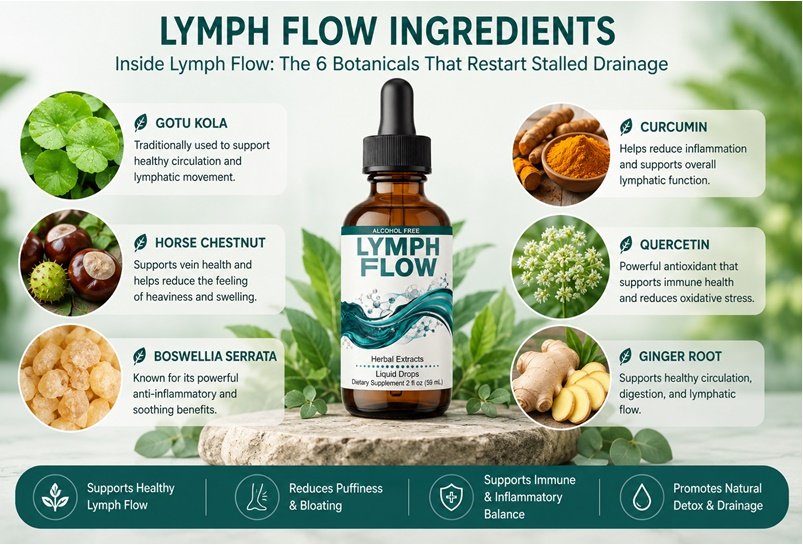
LymphFlow Ingredient List
1. Boswellia Serrata
Boswellia serrata is a resin extract used for centuries in Ayurvedic practice to support joint comfort. Modern laboratory and animal research has found that Boswellia extracts can inhibit inflammatory enzymes (such as 5-lipoxygenase and COX-2) involved in tissue swelling, and a 2022 randomized, placebo-controlled human trial found that a bioavailability-enhanced Boswellia extract, taken alongside curcumin, helped reduce pain and stiffness in people with joint discomfort over a 28-day period.
2. Curcumin (from Turmeric)
Curcumin is the primary active compound in turmeric and has a long history of use in traditional medicine to support the body’s normal inflammatory response. In the same 2022 randomized trial noted above, a combination of curcumin and Boswellia extract showed a synergistic anti-inflammatory effect compared to Boswellia alone, and other reviews have similarly found curcumin-Boswellia combinations among the more studied natural compounds for joint-related discomfort.
Reference: Curcuma longa and Boswellia serrata extract combination study (PMC)
3. Horse Chestnut Seed Extract
Horse chestnut seed extract, standardized to its active compound aescin, is one of the most-studied herbal ingredients for venous circulation support. A Cochrane systematic review of 17 randomized controlled trials found that horse chestnut seed extract was associated with improvements in leg pain, swelling, and itching related to venous insufficiency compared to placebo, and an earlier systematic review reported measurable reductions in lower-leg fluid volume with regular use.
References: Cochrane review on horse chestnut seed extract; Pittler & Ernst systematic review, Archives of Dermatology
4. Gotu Kola (Centella Asiatica)
Gotu kola has been used for centuries in Ayurvedic tradition to support connective tissue and circulation. A systematic review pooling data from eight clinical studies found that Centella asiatica extract was associated with measurable improvements in microcirculation markers and a reduced rate of ankle swelling in people with venous circulation concerns, though the review authors noted that study quality varied and called for more rigorous research.
Reference: Systematic review of Centella asiatica for chronic venous insufficiency (PMC, 2013)
5. Quercetin Phytosome
Quercetin is a plant flavonoid found in many fruits and vegetables, included here in a “phytosome” form designed for improved absorption. Research reviews describe quercetin’s ability to help reduce capillary permeability and support a normal inflammatory response, though most human clinical evidence remains preliminary and researchers continue to call for larger, well-designed trials.
Reference: “Quercetin, Inflammation and Immunity” review (PMC)
6. Ginger Root Extract
Ginger has a long history of traditional use for digestive comfort and inflammation. A 2020 systematic review and meta-analysis of randomized controlled trials found that ginger supplementation was associated with statistically significant reductions in inflammatory markers, including C-reactive protein (CRP) and TNF-alpha, across the pooled studies.
Reference: Meta-analysis of ginger’s effect on inflammatory markers, PubMed (2020)
7. Butcher’s Broom (Ruscus Aculeatus)
Butcher’s broom rhizome extract has long been used in European herbal medicine to support venous tone. A multi-center, double-blind, randomized, placebo-controlled trial involving 166 women with chronic venous insufficiency found the extract to be safe and effective for supporting symptoms of venous circulation over a three-month period, and several earlier trials combining it with hesperidin reported similar symptom improvements.
Reference: Vanscheidt et al., randomized placebo-controlled trial, Arzneimittelforschung (2002)
8. Grape Seed Extract
Grape seed extract is rich in oligomeric proanthocyanidins (OPCs), compounds studied for their role in strengthening capillary walls. A 2013 double-blind, placebo-controlled crossover study found that grape seed extract significantly reduced leg swelling and fluid buildup in healthy women during prolonged sitting, and other clinical research has linked it to improved venous tone and reduced capillary “leakiness.”
Reference: Sano et al., Journal of the Science of Food and Agriculture (2013)
9. Diosmin
Diosmin is a citrus-derived flavonoid and one of the most clinically studied compounds for venous circulation support, commonly used in Europe as an oral “venoactive” agent. Multiple randomized clinical trials have found that diosmin, alone or combined with hesperidin, meaningfully reduces leg pain, heaviness, cramping, and edema associated with venous insufficiency over one to six months of use.
Reference: Review of diosmin clinical trials, Vascular Health and Risk Management (Dove Press)
10. Hesperidin
Hesperidin is a citrus flavonoid frequently paired with diosmin in venous-health research. Studies on the combined diosmin-hesperidin preparation (often called micronized purified flavonoid fraction) have found it improves venous tone, reduces capillary hyperpermeability, and decreases ankle and calf circumference compared with placebo in randomized clinical trials.
Reference: Review of micronized purified flavonoid fraction, PubMed
11. Bromelain
Bromelain is an enzyme complex derived from pineapple stems, traditionally used to support the body’s normal response to minor swelling. Clinical research — including randomized trials in post-surgical settings — has found bromelain supplementation associated with faster reduction of tissue swelling and lower need for anti-inflammatory medication during recovery.
Reference: Bromelain and post-surgical edema study, Journal of Clinical Medicine (2024)
12. Dandelion Root (Taraxacum Officinale)
Dandelion has been used in traditional folk medicine across Europe, Asia, and the Americas as a mild diuretic to support fluid balance. A human pilot study published in the Journal of Alternative and Complementary Medicine found that a dandelion leaf extract significantly increased urinary frequency and output within hours of ingestion — one of the first controlled human studies to support this traditional use.
Reference: Clare, Conroy & Spelman, pilot study on dandelion’s diuretic effect, PubMed (2009)
13. Selenium
Selenium is an essential trace mineral that supports the body’s antioxidant enzyme systems and normal immune function. Systematic reviews of selenium supplementation have found it can help reduce markers of oxidative stress, though researchers note that benefits are most notable in people with an existing selenium deficiency, and more is not necessarily better once healthy levels are reached.
Reference: Systematic review and meta-analysis of selenium and antioxidant markers, PubMed
How These Ingredients Work Together in LymphFlow
Rather than relying on a single mechanism, LymphFlow’s formula combines ingredients studied for venous and lymphatic circulation support (Horse Chestnut, Gotu Kola, Diosmin, Hesperidin, Butcher’s Broom, Grape Seed Extract), ingredients studied for supporting the body’s normal inflammatory response (Boswellia, Curcumin, Quercetin, Ginger, Bromelain), a traditional mild diuretic (Dandelion Root), and an essential antioxidant mineral (Selenium). You can read more about how these systems connect in our lymphatic system guide.
Frequently Asked Questions
Has LymphFlow itself been clinically tested?
The individual ingredients in LymphFlow have been studied in published research, often in different forms, doses, or combinations than found in this product. The LymphFlow formula as a whole has not been the subject of a published clinical trial. This is common across the dietary supplement industry and is one reason it’s worth reviewing the ingredient-level evidence, as this page does.
Are these ingredients safe to take together?
All 13 ingredients are commonly found in dietary supplements and are generally recognized as safe for most healthy adults at typical doses. However, several — particularly Horse Chestnut, Ginger, Diosmin, and Bromelain — may interact with blood-thinning medications or affect blood clotting. Talk to your doctor before starting LymphFlow if you take any prescription medication.
Why is LymphFlow a liquid instead of capsules?
Liquid formulations are generally absorbed faster than capsules, since they skip the breakdown step required for solid dosage forms. This is part of why LymphFlow was formulated as a fast-absorbing liquid dropper rather than a capsule.
Regular Price: $99/per bottle
Only for: $49/per bottle